
Benefits of Sound Healing / Benefits of Sound Bath
Can Sound Healing Help with Stress? What a Sound Bath Can and Cannot Do
Sound healing is often described online in a way that makes it sound both magical and medical. You may see claims that particular frequencies repair cells, reset the nervous system, clear blocked energy or change your brainwaves in a specific way.
I use sound in my wellbeing work, and I do not think we need to make claims that the evidence cannot support in order to explain why the experience can be valuable.
If you spend most of your day thinking, deciding, responding and staying available to other people, a sound bath gives you something many busy professionals rarely receive: protected time in which nothing is being asked of you.
You lie down. You listen. Your attention has somewhere to rest. For some people, that makes it easier to notice the body softening and the pace of their thoughts beginning to slow.
That can be meaningful without being a cure.
The short answer
Sound healing uses instruments such as singing bowls, gongs, chimes and drums to create an immersive sound environment. During a sound bath, participants usually rest while a practitioner plays the instruments around them.
The experience may support short-term relaxation, reduce perceived tension and offer a break from constant mental stimulation. Early research into singing bowls and related sound-based interventions has produced some promising findings, particularly for self-reported tension and anxiety.
The evidence is still developing, however. We cannot currently say that sound healing repairs cells, strengthens the immune system, treats mental health conditions or cures burnout. We also do not know that a particular frequency produces a predictable health effect in everyone who hears it.
I see sound healing as a complementary wellbeing practice: something that may support rest, awareness and stress regulation, but not a replacement for healthcare, psychological treatment or changes to an unhealthy working environment.
Why might sound help you unwind?
This is the part I think is often made more complicated than it needs to be.
You do not have to believe that each sound has a special healing frequency. You also do not have to empty your mind or be good at meditation.
Sound gives your attention something immediate to follow. A tone appears, changes and fades. Another sound begins. When your attention wanders back to tomorrow’s meeting or the message you forgot to send, the next tone gives you somewhere to return.
The setting matters too. You are usually lying or sitting comfortably, the lights are lowered, your phone is away and you are not expected to speak, solve anything or look after anyone else. For someone who has spent the day in a high-pressure role, those conditions alone can create a noticeable contrast.
As the session continues, you may become aware that your breathing has slowed or that you are no longer holding your shoulders as tightly. That does not mean a switch has been flipped or your nervous system has been “reset”. It means the experience may be giving your body an opportunity to move away from sustained activation.
Stress activation is normal. The aim is not to remain calm all the time. The difficulty comes when the working day ends but your body continues as though the demand is still happening.
What does a sound bath actually feel like?
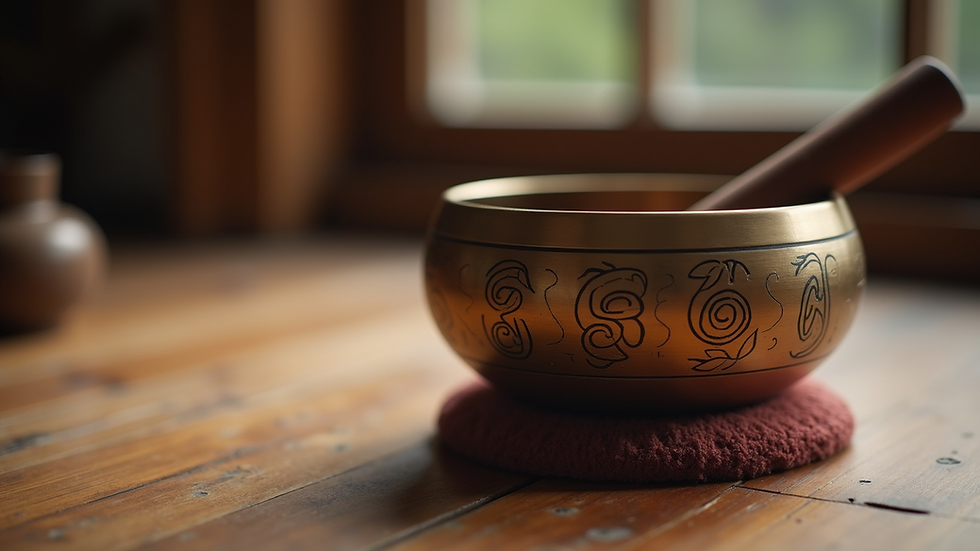
A sound bath is usually experienced lying down, although you can sit if that is more comfortable. The practitioner plays a sequence of instruments, which may include Himalayan or crystal singing bowls, a gong, chimes or other resonant sounds.
Some sounds are soft and simple. Others feel fuller and more physical, particularly when a gong is played. You may notice the sound as vibration, but you do not need to interpret what each sensation means.
People respond differently. You might feel deeply relaxed, become aware of tension you had not noticed before or simply enjoy listening. Some people become sleepy; others remain alert but feel less mentally crowded. There is no correct experience or requirement to reach a special state.
A useful change may be as simple as your jaw feeling less tight or the usual internal rush feeling quieter.
What does the research on sound healing show?
Research specifically examining singing bowls and sound baths is still limited.
One observational study involving 62 adults found that participants reported less tension, anger, fatigue and low mood after a singing-bowl meditation. This is encouraging, but the study did not include a control group. It therefore cannot tell us how much of the change came from the instruments themselves and how much came from resting, the environment, attention, expectation or the passage of time.
A 2025 systematic review identified 19 clinical studies of singing-bowl interventions. The review found possible benefits across some psychological outcomes, including anxiety, but the studies used different populations, methods and comparisons. The reviewers judged the randomised trials to have a high risk of bias and concluded that better-designed research is needed.
Broader research into music-based interventions suggests possible benefits for stress and anxiety in some settings. Sound healing is not identical to these interventions, so this cannot be treated as proof for singing bowls or gongs.
The evidence is not strong enough for the dramatic health claims often used in wellness marketing.
What sound healing may realistically help with
Creating a clear transition out of work mode
Many people close the laptop while the meeting continues in their head. A structured sound session can create a boundary between the demands of the day and recovery time.
Reducing mental input
There is nothing to read, answer or decide. Following sound can feel more accessible than silent meditation when silence gives thoughts more room to race.
Noticing physical tension
You may notice where you are bracing: the jaw, shoulders, hands or stomach. This does not remove the source of stress, but it can help you recognise your body’s signals earlier.
Making space for rest
A facilitated session gives you permission to pause without turning relaxation into another task to perform correctly.
What sound healing cannot do
Sound healing cannot make an excessive workload sustainable. It cannot resolve workplace conflict, replace appropriate staffing or create boundaries on behalf of an organisation.
It should not be presented as a cure for burnout. The World Health Organization describes burnout as an occupational phenomenon arising from chronic workplace stress that has not been successfully managed. A sound bath may provide a period of recovery, but the causes of that stress may still need to be addressed.
Sound healing is also not a treatment for depression, anxiety disorders, chronic pain, insomnia or other medical conditions. It can sit alongside appropriate care, but it should not delay someone from speaking to a GP or another qualified healthcare professional.
If symptoms are persistent, severe, unexplained or significantly affecting daily life, seek professional advice rather than assuming stress is the only cause.
How to decide whether a sound bath is right for you
Ask the practitioner what the session involves, which instruments will be used and how loud it may become. A responsible practitioner should be comfortable explaining the process without promising medical outcomes.
Tell them in advance if you experience tinnitus, migraines, hearing difficulties, sound sensitivity or another condition that may be affected by loud or sustained sound. You should be able to position yourself farther from an instrument, use hearing protection or leave the room if you become uncomfortable.
Notice how the practice affects you rather than how you have been told it should feel. If it leaves you uncomfortable or overstimulated, it may not be the right practice for you.
Frequently asked questions
Is sound healing scientifically proven?
There is preliminary research suggesting that singing-bowl and music-based interventions may support relaxation and reduce some self-reported stress or anxiety outcomes.
However, studies specific to sound healing are still limited, varied in quality and often at high risk of bias. It is more accurate to describe the evidence as promising but not conclusive.
Can sound healing help with sleep?
A relaxing session may help some people wind down before bed, and broader music research suggests possible benefits for subjective sleep quality.
Research specific to singing bowls and insomnia is inconsistent, so sound healing should not be described as a treatment for sleep disorders.
Can a sound bath help with burnout?
It may offer a period of rest and help you notice how much tension you are carrying. It cannot remove the workplace conditions creating burnout.
Recovery may also require changes to workload, boundaries, support and working practices, with professional help where appropriate.
How many sessions do I need?
There is no established therapeutic dose for sound baths. Some people notice a short-term shift after one session; others simply find it an enjoyable way to pause.
Be cautious of anyone guaranteeing a particular result after a fixed number of sessions.
What if I find the sound uncomfortable?
You do not need to remain with a sound that feels painful or overwhelming. Move farther from the instrument, use hearing protection or tell the practitioner that you need the volume adjusted.
A wellbeing practice should not require you to ignore your body’s warning signals.

Experiencing sound without the exaggerated claims
Sound healing does not need to repair your cells or change your life to be worthwhile.
Sometimes its value is much simpler: for a period of time, you are not working, responding or performing. You are listening and noticing what happens when the usual demands become quieter.
If you would like to experience this for yourself, I offer private sound healing sessions and group sound baths using Himalayan singing bowls and gong. To discuss which option may suit you, book a clarity call or email contact@harmonybytundie.com.
Sources
Cai et al. (2025): Therapeutic effects of singing bowls—a systematic review of clinical studies
Goldsby et al. (2017): Effects of singing bowl sound meditation on mood, tension and wellbeing
US National Center for Complementary and Integrative Health: Music and Health—What You Need to Know
World Health Organization: Burn-out as an occupational phenomenon



Comments